We use cookies to make your experience better. To comply with the e-Privacy directive, we need to ask for your consent to set the cookies. Learn more.


Direct Vision Standard (DVS)
The Enhanced Progressive Safe System (PSS) represents a significant advancement from Transport for London's (TfL) current Direct Vision Standard (DVS) Safe System, offering a smarter and more sophisticated approach to road safety. With the introduction of DVS 2024, important changes are set to be implemented, including the requirement for Moving Off Information Systems (MOIS) and Blind Spot Information Systems (BSIS). These two key systems are designed to provide active warnings to drivers regarding potential and imminent hazards of different moving objects, such as pedestrians, cyclists, and other dangers present in blind spots.

The Addition of BSIS & MOIS Sensors
The biggest difference between the DVS Safe System and the enhanced Progressive Safe System is the incorporation of BSIS and MOIS sensors. These systems play a pivotal role in enhancing safety by actively alerting drivers to the presence of individuals and obstacles in both the front and nearside blind spots of the vehicle. To comply with DVS 2024 regulations, vehicles must be equipped with sensors capable of intelligently differentiating between Vulnerable Road Users (VRUs) and other roadside obstacles. The technology must also possess the capability to predict collisions based on the vehicle's trajectory and the travelling speed of the VRUs.
It is essential for any retrofitted Blind Spot and Moving Off Information Systems to meet the performance requirements outlined in the Progressive Safe System (PSS) technical specifications. These specifications are tailored to ensure optimal functionality and compliance with regulatory standards.
A Closer Look at MOIS
New DVS regulatory standards mandate the implementation of Moving Off Information Systems to mitigate risks associated with front blind spots. A MOIS is designed to alert the driver of the presence of vulnerable road users in the critical blind spot area at the front of the vehicle. This is achieved through the activation of a proximity information signal when pedestrians or cyclists enter the designated detection zone while the vehicle is stationary with the brakes applied.
The system must provide accurate and timely warnings, escalating to a collision warning if the driver initiates the vehicle to move off from a resting position. It is crucial that MOIS utilises an 'active' front sensor system capable of reliably detecting vulnerable road users without triggering false alarms. Vehicles that are equipped with a front sensor system, adhering to the UNECE Regulation 159 demonstrates compliance with the MOIS requirements. This regulation ensures that the system effectively detects and warns drivers of potential collisions with vulnerable road users, enhancing safety standards on the road.
Upon detecting a vulnerable road user in the front blind spot area, MOIS must provide a visual signal to the driver, indicating the presence of a potential hazard. This visual cue serves as a crucial prompt for the driver to exercise caution and take necessary evasive actions. Additionally, if the vehicle begins to move off while a vulnerable road user is detected, escalating to an imminent collision scenario, an audible alarm signal must sound. This dual-alert system ensures that drivers are adequately warned of potential dangers, minimising the risk of accidents.
A Closer Look at BSIS
Blind spots pose significant risks on the roads, particularly for vulnerable road users. To address this concern and prevent left-turn collisions, Blind Spot Information Systems are now a crucial component of vehicle safety measures. Ensuring full coverage down the nearside of rigid vehicles, a BSIS utilises active sensors to provide drivers with adequate warning of the presence of vulnerable road users. A vehicle that complies with UNECE Regulation 151 will meet these safety standards.
BSIS is designed to offer comprehensive coverage down the nearside of vehicles, utilising active sensors to detect vulnerable road users. This system is programmed to activate only when necessary, providing warnings to drivers without being triggered by other roadside obstacles. UNECE Regulation 151 ensures that BSIS effectively detects and warns drivers of potential hazards, thereby reducing the risk of accidents and collisions. By meeting these regulatory requirements, vehicle manufacturers and operators prioritise the safety and well-being of everyone on the road.
BSIS sensors must be strategically positioned on the vehicle to maximise effectiveness. For articulated vehicles, sensors on the tractor unit provide sufficient coverage of the nearside without being activated by the trailer itself. Additionally, sensors must extend rearward to areas adjacent to semi-trailers ensuring comprehensive detection capabilities in the defined zone. By providing drivers with timely warnings of the presence of vulnerable road users in blind spots, BSIS mitigates the risk of accidents during manoeuvres such as left turns.
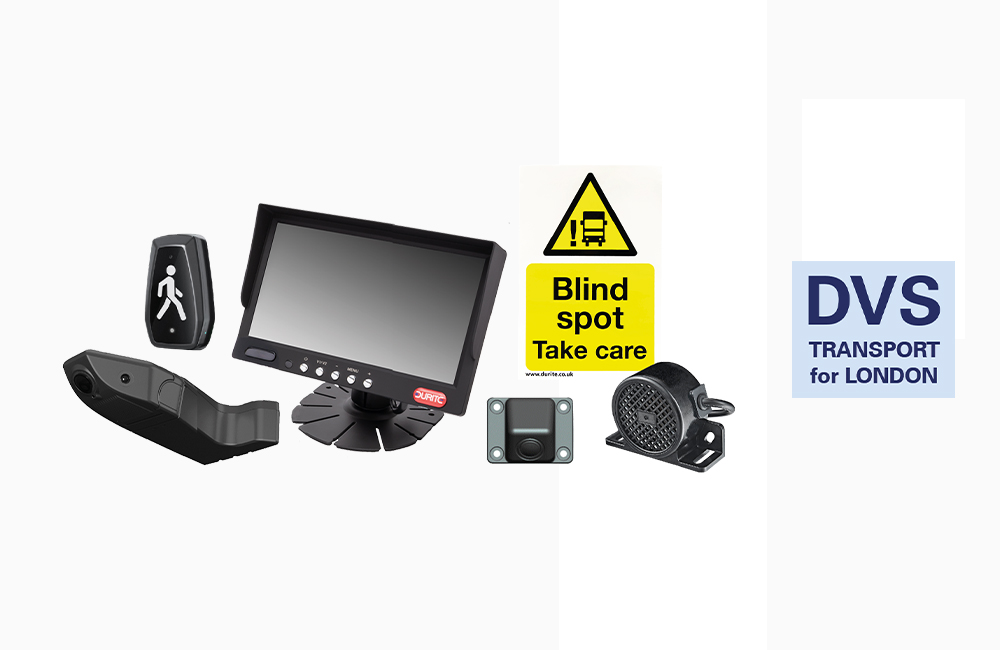
Durite’s Progressive Safe System
When it comes to enhancing road safety, Durite's Progressive Safe System (PSS) offers a comprehensive approach to meet the specifications provided by Transport for London (TfL). With integrated Blind Spot Information System and Moving Off Information System, compliance with Direct Vision Standard, and a commitment to quality, Durite's PSS solution ensures optimal safety standards on the road.
Durite's complete PSS solution is designed to align with the specifications outlined by TfL. An additional benefit to our BSIS is that it comes with a built-in left side Camera Monitoring System (CMS) that completely eliminates the blind spot down the nearside of the vehicle, which is also one of the DVS Phase 2 requirements. By incorporating BSIS and MOIS functionalities, our solution addresses blind spots and provides real-time active warnings to drivers, enhancing overall safety for vulnerable road users and drivers. With a focus on meeting regulatory requirements, Durite's PSS solution offers peace of mind to operators and ensures compliance with TfL standards. Contact us for more information on Durite’s Progressive Safe System.